


The amount of lore (most of it erroneous) that will accrete around a given recipe over decades—let alone centuries—can sometimes be astonishing to the unprepared researcher. The quality of a given dish can be attributed to all kinds of causes: specific measurements of ingredients, secret additives, unspecified characteristics lent to the food by being sourced or made in a particular area. And naturally, in the Kingdoms, all kinds of rumors may spring up about magic being somehow involved—sorcery, the blue Fire, or even the direct intervention of the Goddess.
In the Four Realms, few items of cookery have suffered more from this kind of speculation than the roast chicken that comes out of the royal kitchens of Kynall Castle. Some of this notoriety will inevitably have to do with its source, as the kitchens themselves naturally have their own reasons for fame. Though not quite as old as the ancient Castle proper, in their earliest form they do at least date back to the early 1300s p.A.d.;1 and their extension in the following century brought with it the establishment of the first and largest royally-subsidized communal kitchen in the Four Realms.
The tradition of such community resources naturally did not begin in Arlen. Though pre-Realms history before recordkeeping began is understandably spotty, both tradition and folklore suggest that such kitchens originally first started being informally organized by immigrants making their way slowly westward across the nascent Four Realms during the earliest centuries of human recovery. Hamlets and villages, and (eventually) small towns, began establishing such local storage hubs and kitchens as a hedge—sometimes seasonal, sometimes year-round—against localized food shortages or crop failures. In times of (at least relative) plenty, townsfolk or neighbors would set aside space to store extra food and grain ahead of the winter months, both for themselves and for neighbors who might fall into difficulty. There may additionally have been a connection to the Autumnal festival tradition of Aerrudath, the Lady’s Table, during which all those visiting or passing a household are fed from a spread of the season’s bounty.
Even in Arlen’s heart-city Prydon—where recordkeeping has historically been better due to the royal archives it protects—the reasons for the early establishment of a royal kitchen where all comers were fed without question remain uncertain, due to the lack of specific documentation. Certainly Héalhra himself is traditionally quoted as having said, “As She feeds us freely, demanding no price, it well behooves us when we may to feed others as she feeds us.” So the temptation to treat the royal Kitchens as an organic development of this sentiment is strong… but perhaps flawed.
The rationale may be far more straightforward in a culture where food security is significantly more fragile than ours—and one where tales of the dreadful Realms-wide famine associated with the great Dark are unsurprisingly never far below the surface. The essential responsibility of royalty to keep their people not merely safe, but fed, is never far from the minds of either the rulers or the ruled; and Kynall Castle’s kitchens are a concrete, everyday sign of the royal side of that compact being kept. Any hungry person, from anywhere, can walk in the Kitchen’s gates by day or night and know that for no price asked, they will be given (as the saying goes) “food and drink and all things needful”.
The current sejant of the White Throne takes his responsibility for the Great Kitchen quite seriously, and this has apparently resulted in occasional enthusiastic discussions (and apparently some disagreements) between Throne and Hearth on the structure and features of the day-to-day menu offerings. But there have been no discussions whatsoever about the roast chicken… except for one member or another of the royal household being heard to mention loudly that Sixday Is Roast Chicken Day, and they want to get down there and get some of it. In this regard, the population of Prydon in general appears to agree with them. Sixday meals are by far the Great Kitchen’s most heavily attended ones, and visiting dignitaries must just queue up for as long as any of the local working people who’re dropping by to grab a quick quarter-chook for their nunch.
It perhaps smacks of the anticlimactic to discover that the secret of the roast chicken itself turns out to be not so huge a secret…assuming that you can get the famously closemouthed and misdirection-loving Master of the Kitchens to discuss it without his tongue in his cheek. Master Ulten has been known to spin casual inquirers straight-faced tales about unusual ingredients and (most recently, due to changes in the royal House) the possible involvement of the blue Fire. However, sources close to the roasting ovens have revealed two important aspects of the chickens’ treatment once they pass through the Kitchen’s portals. One is prolonged brining in a solution based on assorted “warm” spices, two different sugars (these slightly specialized ingredients fortunately not difficult for the Kitchens to obtain due to their royal patron’s papermaking connections), Westwall-mined rose salt, and concentrated sycamore syrup—in this case deriving from the Kingdoms’ variant of Acer pseudoplatanus, the “European” sycamore or sycamore maple, which grows plentifully in the mixed-forestry regions adjacent to the southern Highpeaks in Arlen. Locally-bred, grain-fed chickens destined for the Kitchens spend anywhere from several days to a week in this brine, depending on their tenderness, age, and various other qualities (particularly the season of the year).
After that, according to our privileged source, the secret is apparently not blue Flame, but expert management of the red kind. Interestingly for the Kingdoms (where roasting normally takes place in front of an open fire), the chickens are cooked in stone ovens of Darthene basalt, fired far hotter than a household or town oven can achieve, while smoking woods are added at varying times during the process. Apple and hickory are favored, but again, Master Ulten will admit to using different woods if a given batch of chickens seem to require it, or if there are local shortages. The remaining part of the “secret” is simply expertise: months or years of working with the chickens, the seasonings, and most specifically the way the ovens handle their firewood, and their fire, as the seasons turn.
In our own alternate Earth, sycamore syrup is relatively hard to find. So it’s just as well that maple syrup substitutes straightforwardly into this recipe without damage to the desired flavor. (Possibly a finicky cook in our world might add some lemon juice to the brine to simulate the slightly more acid quality of sycamore syrup.) The associated spicery of the brine is nothing too exotic to be easily found on our Earth. What counts in this dish is time, and care taken… the most basic kind of magic.
Check the Recipe tab above for the details.
1 The commonly-used abbreviation for pai Ajnedäre derüwin: “since the Arrival”—i.e. of the Dragons, and therefore since the destruction of the Dark.
For the brining stage of this recipe, you’ll need a plastic bucket that will hold at least a gallon and a half of liquid.
For the smoking/roasting stage: you need either a smoker, or a covered BBQ large enough to hold an entire chicken and smoking chips for it.
For the smoking wood: always use hardwoods only, as soft woods contain too much moisture and will create an acrid smoke that won’t be at all good with your chicken. Preferred woods for this dish would be hickory, apple, pecan (if you can get it), and even maple.
Ingredients:
For the brine:
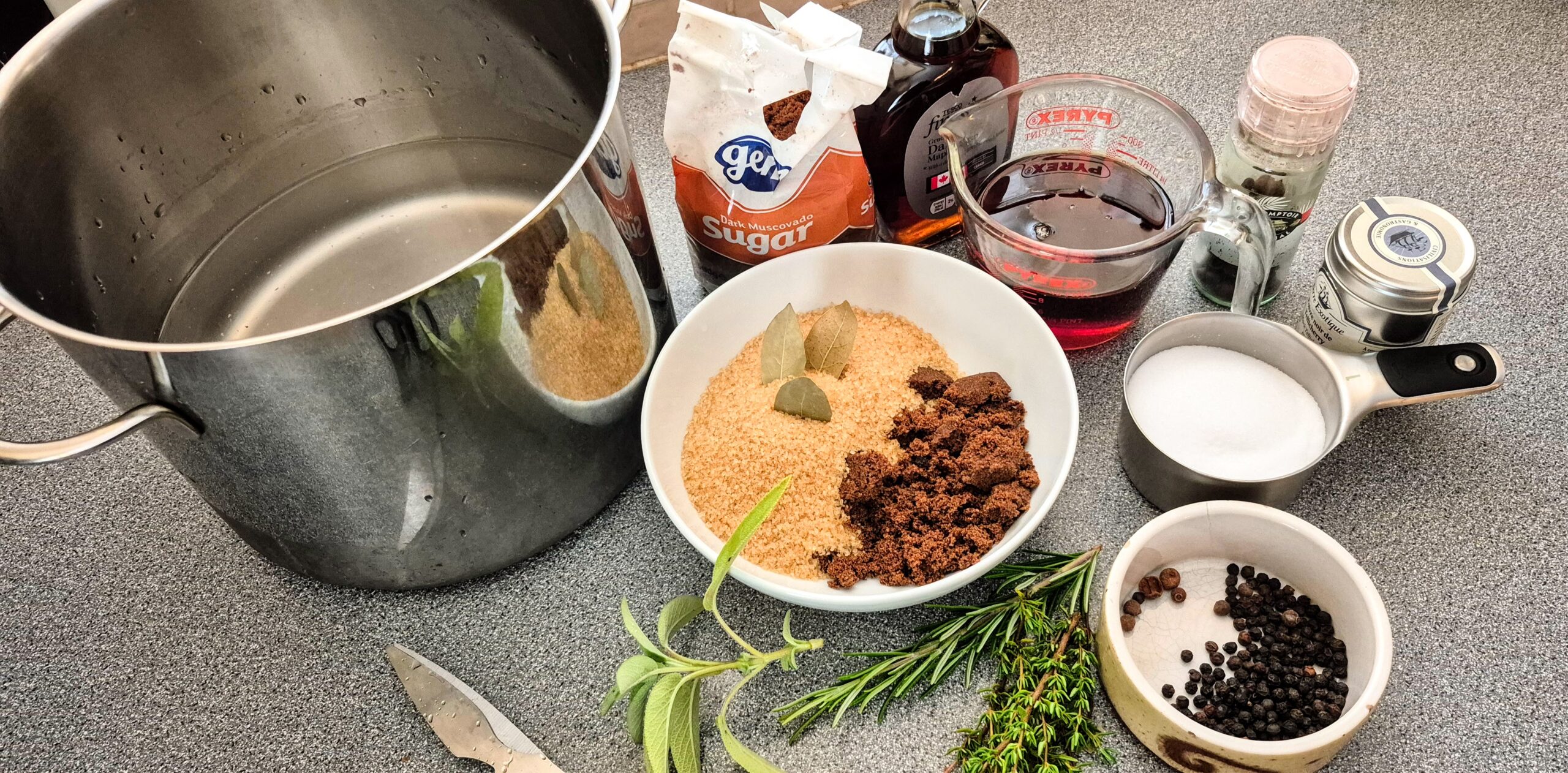
- 1 gallon water, divided: 2 quarts to dissolve the upcoming sugar and spices in, 2 quarts to cool the brine afterwards
- 1 cup dark brown sugar
- 1 cup light brown sugar
- 1 teaspoon ground allspice (freshly coarse-ground if possible)
- 1 cup maple syrup
- ¾ cup sea salt
- 6 bay leaves
- 3 large fresh thyme sprigs, bruised
- 2 large fresh rosemary sprigs, bruised
- 1 large sage sprig, bruised
- 2 tablespoons whole black peppercorns
- If liked: 1 tablespoon dried birdseye chilies
- If liked: 1 cup whiskey (ideally a smoky one like Laphroiag)
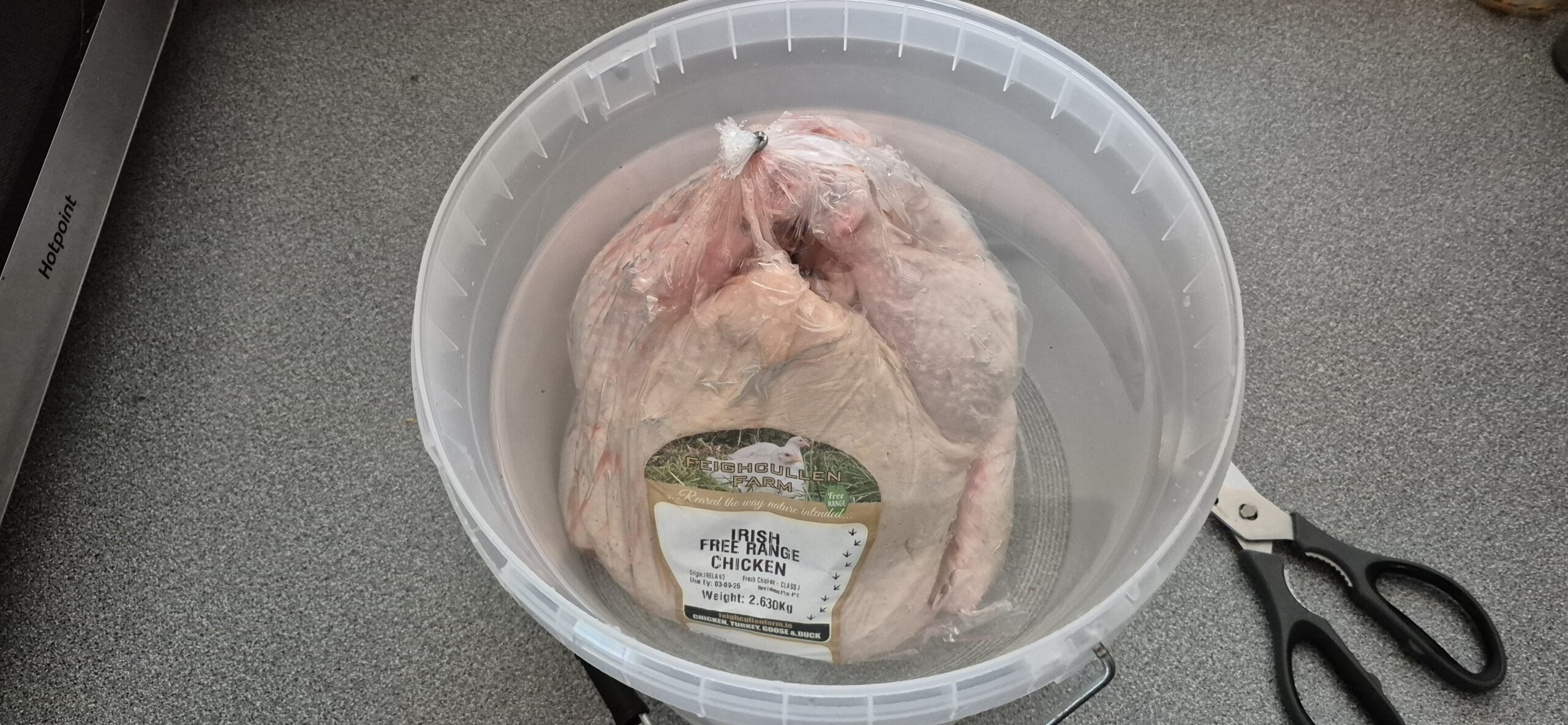
First of all: put all of your water in the bucket with the chicken and make sure the bucket’s the right size for the chicken to be completely submerged in the liquid. This chicken, as you can see, is about 2.6 kilos, or nearly 6 pounds. (If you’re going to go to this much trouble for a chicken, it might as well be a big chicken.)
Now. Pour half that water into a large stainless steel (or other nonreactive) pot and bring it to the boil. Add the sugars and salt and stir well as the water comes up to the boil so that they dissolve completely. Then add the spices and herbs, let everything boil together briefly, and remove the pot from the heat.
Let it cool down, and when it’s come down to room temperature, add the rest of the water (and the whiskey if you’re using it. Arlenes would use any one of a number of grain-based spirits, some of them including smoked barley: but the royal Kitchens don’t add this). Put the chicken into the brining bucket and pour the cool brine all over it. Make sure the chicken is completely submerged; turn it as necessary to make sure the chicken’s inside cavity is completely full of liquid and has no air pockets in it. (If you have a small weight, you may want to sit this on a plate on on top of the chicken to keep it under the surface. See how your own chicken behaves.)
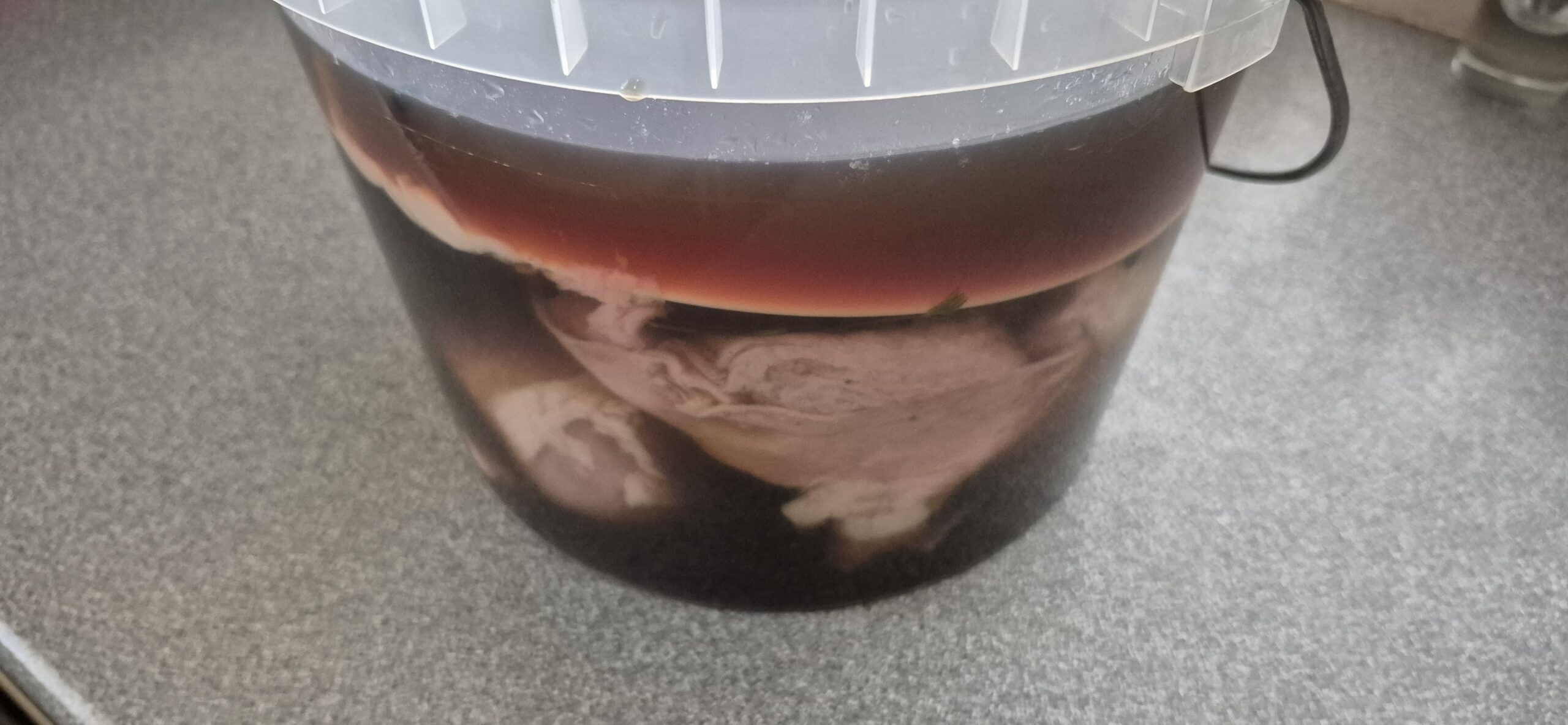
Then cover the whole business—with the bucket’s own cover, or some clingfilm/Saran Wrap and a plate—and stick it into the fridge.
The chicken should remain in the brine for, at the very least, 24 hours… but 72 hours will produce a far better result.
When it’s had your preferred amount of time in there, pour off the brine (which you won’t be needing any longer), make sure all the liquid’s drained out of the inside of it, and pat the chicken dry.
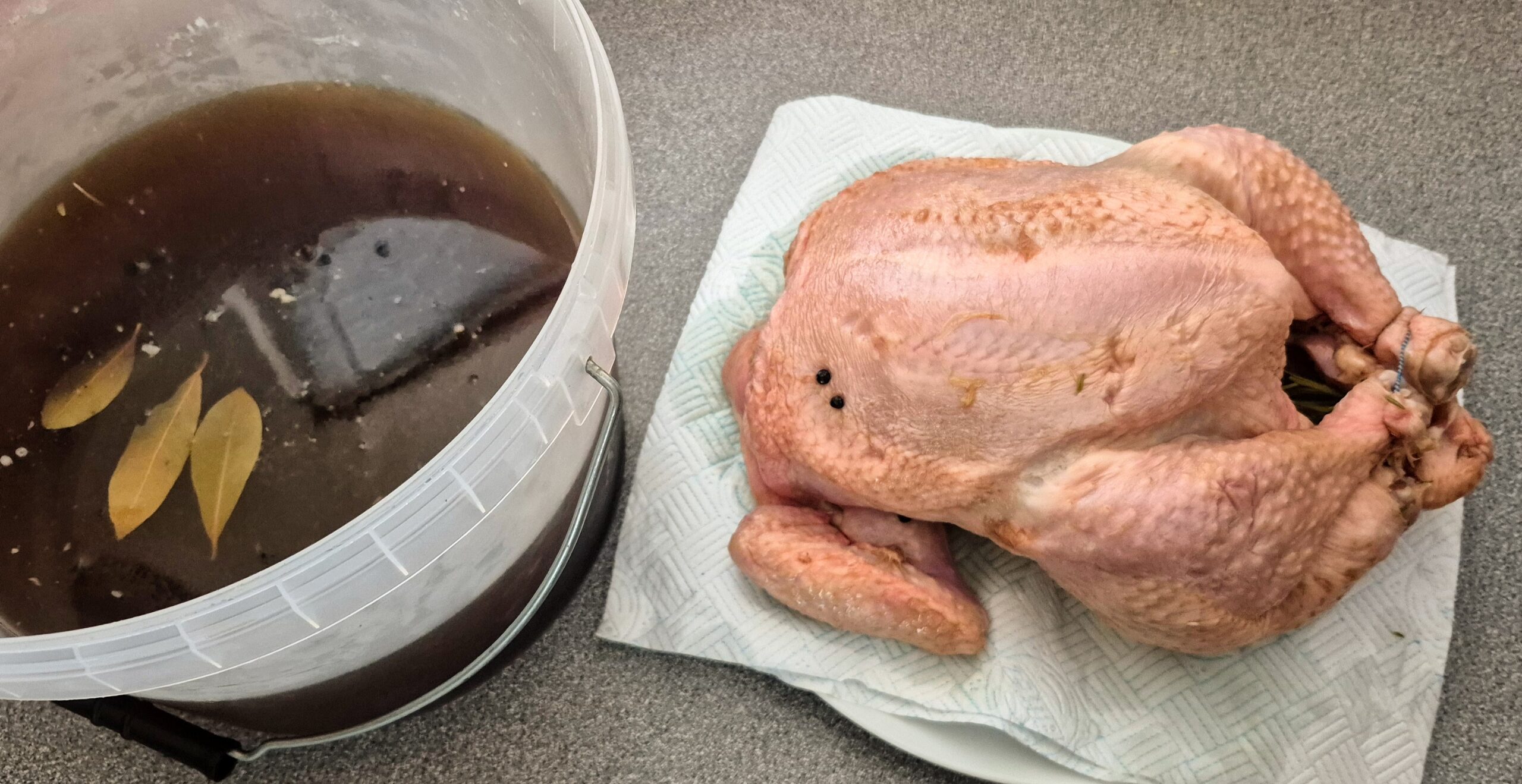
As we’ve done here, use cotton twine to truss the chicken’s wings and legs together, so that when you turn the chicken during the roasting/smoking period, they won’t flop around.
Oil the chicken all over with vegetable or olive oil (which would work fine, as olives and their oil are known and grown in the Kingdoms) and season with salt, fresh-ground pepper, and allspice (again, fresh ground if you can get it. Allspice is one of the Kingdoms’ favorite spices for roast fowl). If you like to, you can also add granulated garlic to the seasoning. Make sure not to miss the bottom of the chicken when seasoning, or the spaces between legs and wings.
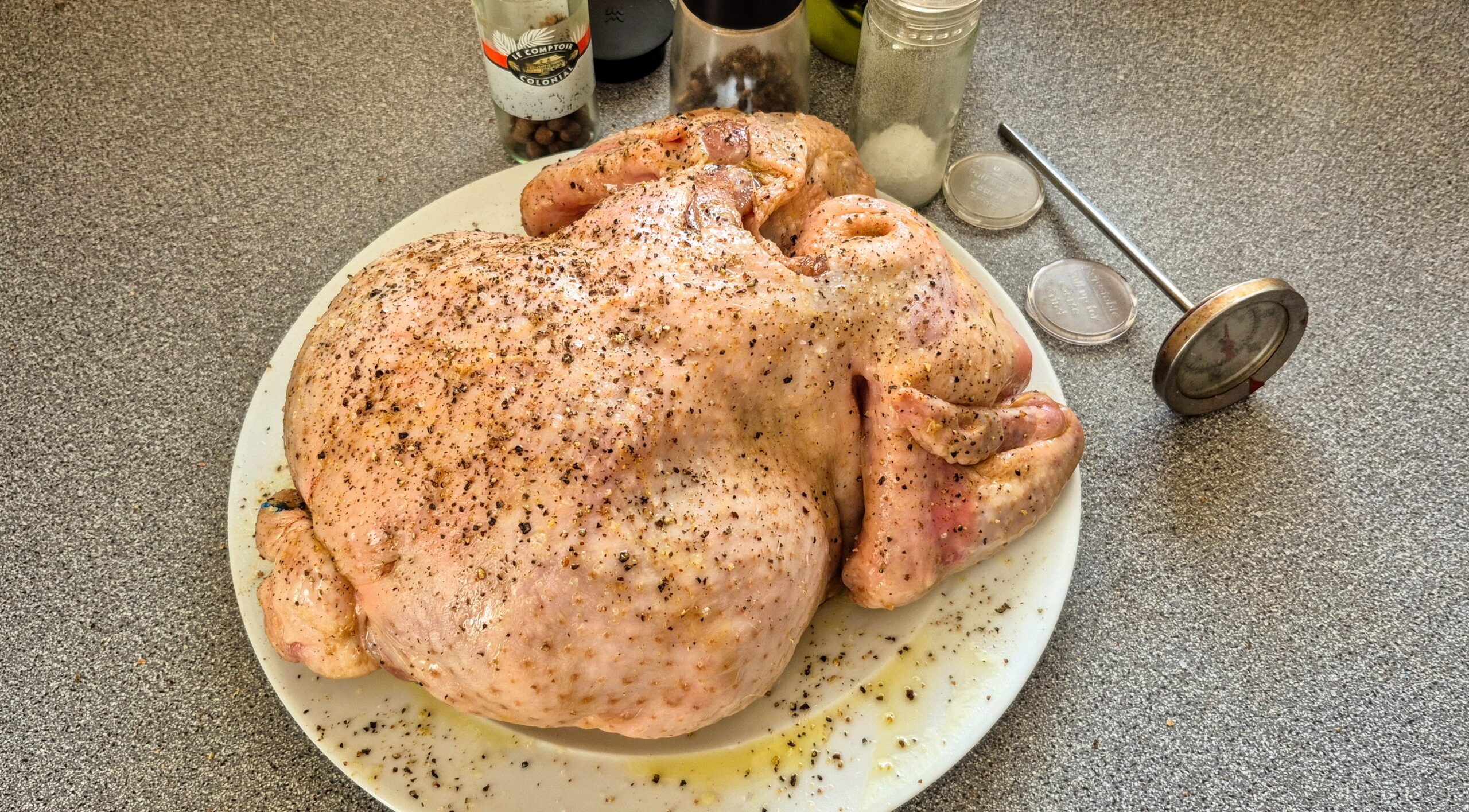
Meanwhile, this is when you should start your smoker or BBQ preheating. Charcoal is the preferred fuel.
Once the initial fire has burned down enough for the charcoal pieces to start whitening around the edges, add your preferred smoking chips or wood—ideally soaked first, to keep it from burning away too quickly. (We used a combination of maple and mesquite for this chicken, which worked really nicely.)
Then add your chicken (with a cooking thermometer or probe stuck into the breast meat) on a grill well above the fire. Once it’s in place, close the smoker or BBQ up.
Your target temperature for the BBQ or smoker should be around 275F. You will want to hold it at or near this temperature for between two and three hours: so keep an eye on things, being prepared to add more charcoal if necessary, and more smoking wood if you feel the need.
About halfway through your cooking time, open the smoker or BBQ up to see how things are going. This is a good time to give the chicken a spray or sprinkle of whatever kind of oil you rubbed it with, to help the skin crisp up.
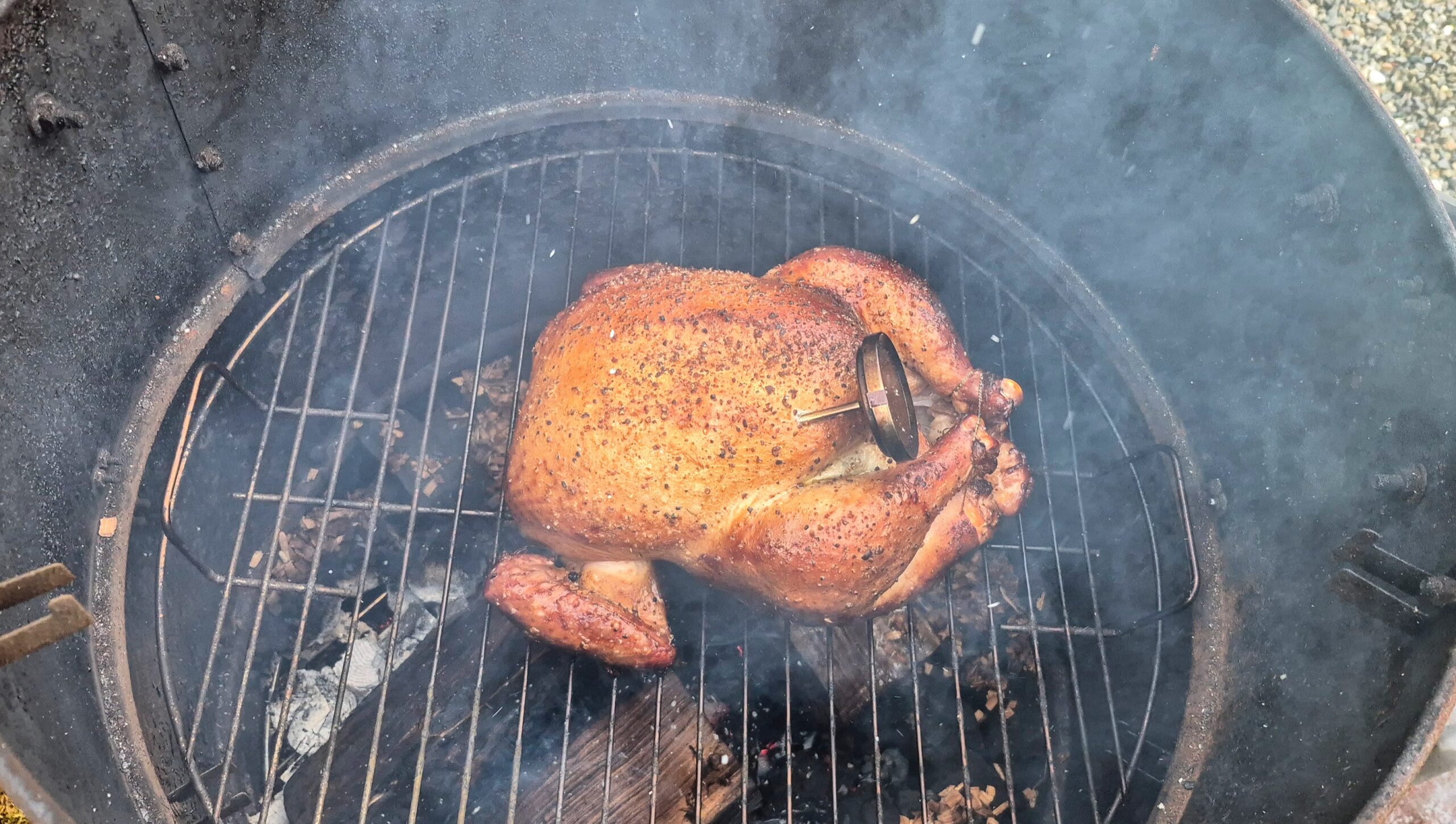
This is also a good time to turn the chicken around to make sure that all its sides are getting equal access to the smoker’s heat. You can of course turn it breast-side down for a while, if you like and if you don’t mind grill marks on the top.
The ideal interior “cooked” temperature for the chicken will be 165F (which it should have reached, or be very near to, at the two-hour point). The thigh temperature (if you elect to reposition the thermometer) should be about 175F. …If you want to cook the chicken a little more thoroughly than this, feel free by all means: but be careful to check the texture and springiness of the meat, with an eye to keeping it from becoming too dry.
When the chicken’s done, remove it from the smoker and allow it to sit and rest for at least twenty minutes before carving.
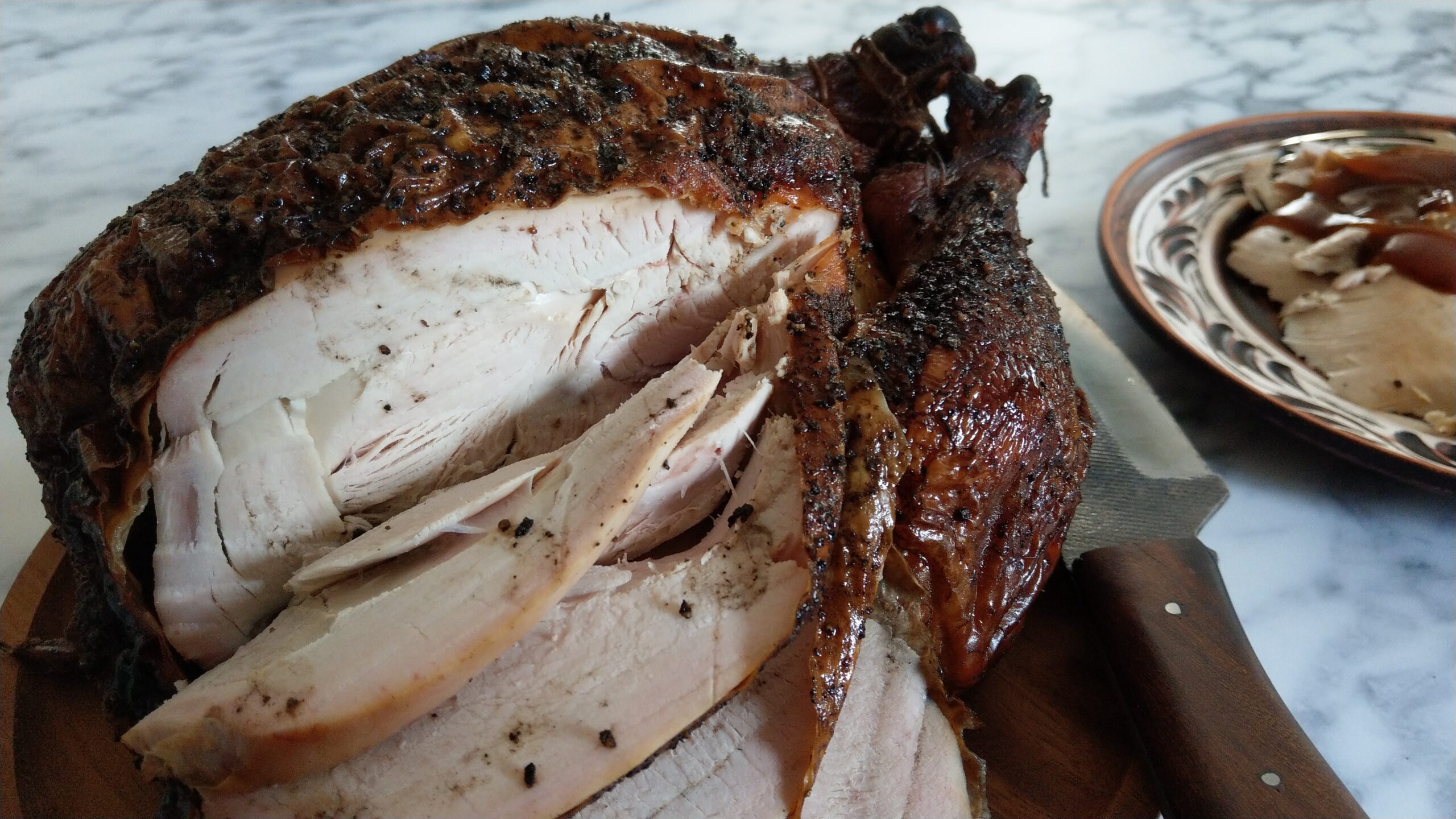
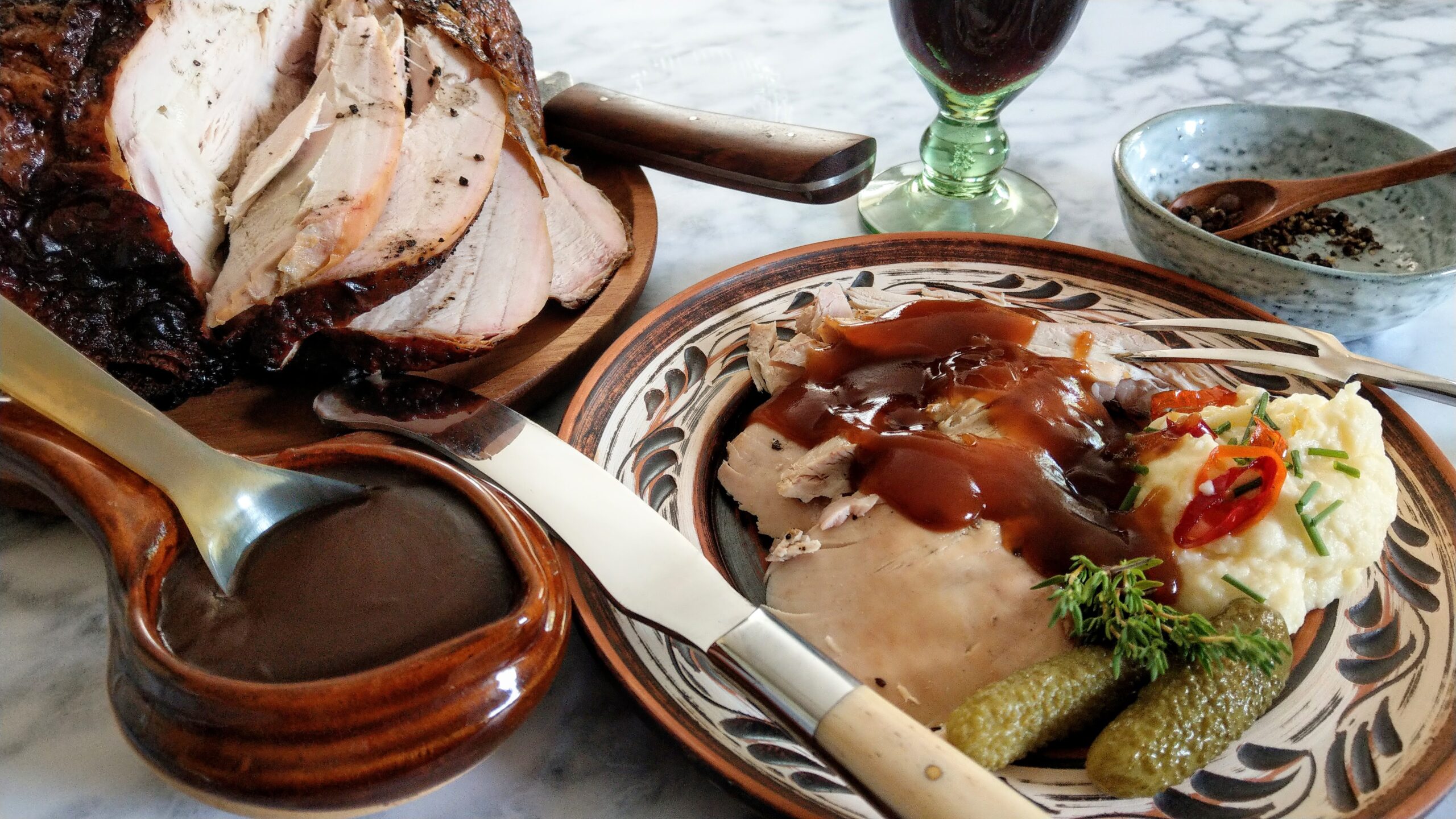
What you prefer to serve this chicken with is very much your call. Our staged image here shows it with the parsnip, cream and spiced butter recipe featured elsewhere on the site.
In any case: enjoy!
Fruit, pastry, sweets, desserts, pies

SuperValu, Polonez, Moldova