


With three out of four of the Middle Kingdoms having direct access to the Sea, and all of them possessing major river systems that drain their territories, it’s no surprise that salt-water and fresh-water fish—either fresh-caught or preserved—make up a significant portion of the diets of people all across the four Realms.
One of the most widely available of these fish is a small silvery salmon-relative also found in numerous rivers, lakes and seas of our own world. All the major rivers of the Kingdoms feature various species of the genus known on Earth as Coregonus—the “whitefishes.” In our world as in the Kingdoms’, these fish occupy a food-chain niche between smaller river- and ocean-living fish and the crustaceans on which those live, and larger fish like perch and pike that predate on the whitefishes.
Some of these coregonids, like the vendace or European lake herring (Coregonus albula), live almost entirely in continental lakes and rivers associated with generally temperate regions, and never leave them. Others, like the Arctic cisco (Coregonus autumnalis), mostly prefer cold subpolar regions and are to a greater or lesser extent migratory. From their home rivers they migrate sporadically (or sometimes yearly) to feeding grounds in the nearest ocean. Some species may live for a number of years at sea, even as much as a decade, before returning to their native rivers’ spawning grounds, there to mate and die.
In the Kingdoms, the upper and middle reaches of both the Arlid and Darst rivers are home to large populations of Xenocoregonus medioregnis sp.—several species of salmonids usually referred to as “silvershoal” (Arl. and N.Arl niweberl, Dar. eibeirel, Stel. nuwekbhei). The name comes from their tendency to congregate in dense shoals of tens of thousands in their oceanic feeding grounds, and to migrate in similar numbers near their spawning time. These populations support large seasonal fisheries that make up a significant contribution to the food supply of the Brightwood, northern Darthen, and both Arlen and North Arlen. Hundreds of thousands of each autumn’s silvershoal catch are smoked, pickled or dried for consumption as a cold-season staple, Many more become summertime or autumnal specialty dish usually involving brining or cool-smoking, and featuring unique regional seasonings.
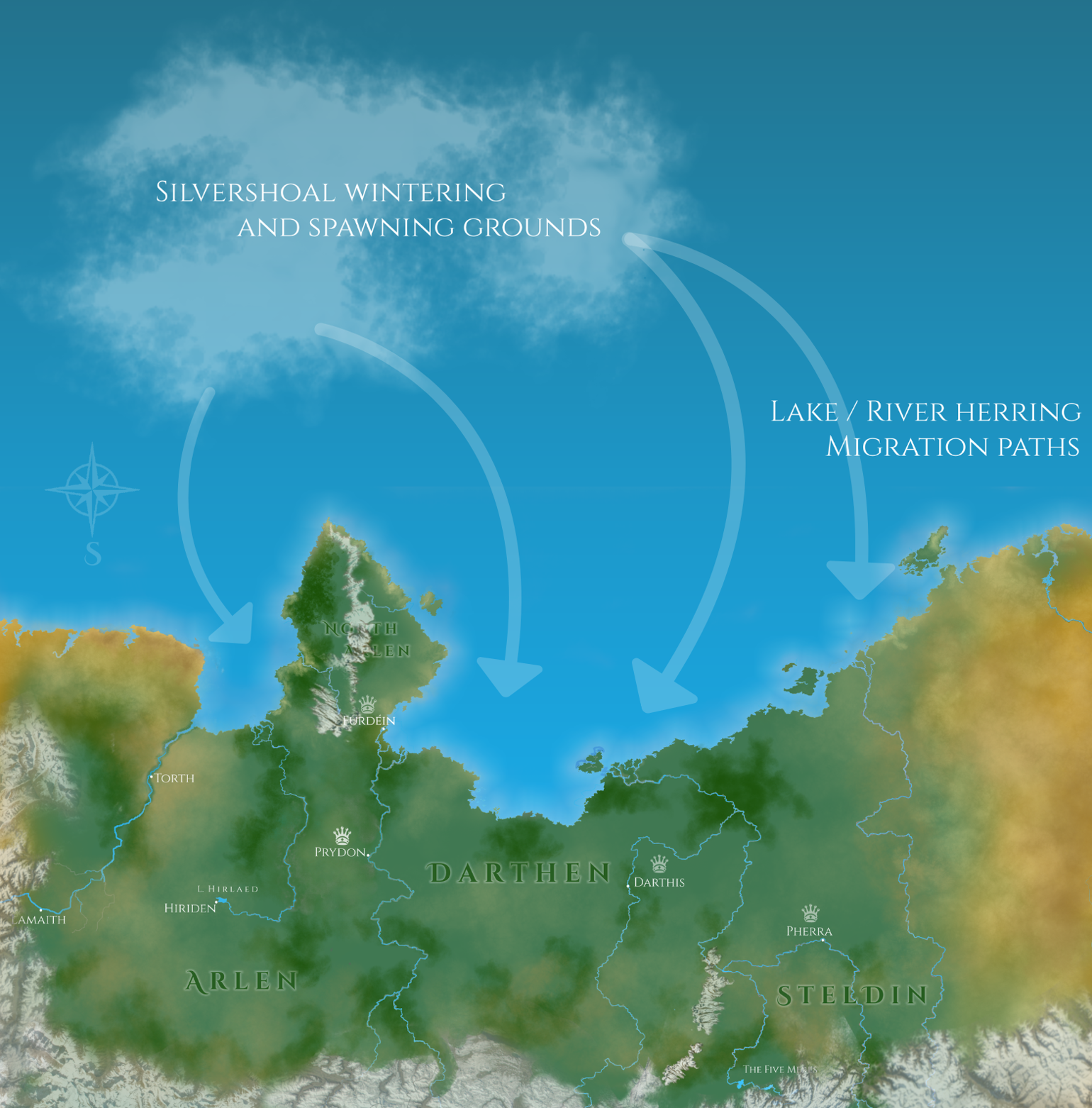
The rare extant lake populations of the Four Realms’ whitefishes, however, operate differently. At some point before the Kingdoms-continent’s most recent glaciation (about thirty thousand years ago), some silvershoal groups that had previously routinely migrated up and down the eastern Arlid, and upward to the Sea from the middle Darst, became trapped in the lakes from which these drained—specifically Lake Hiriden in Arlen, and the Five Meres in the eastern Highpeaks between far southern Darthen and western Steldin.
As is so often the case, difficulty of access renders some resources more valuable… sometimes seemingly irrationally so. Silvershoal from these lakes are highly prized for various reasons that only rarely seem to have anything to do with their flavor. Fresh fish from Lake Hiriden have historically been particularly sought-after in Arlen, to the point where some hundreds of years back there was a once-a-decade “fish race” that carried catches of live silvershoal to Prydon, where the ruler would ceremonially release all but one of the winning catch into the Arlid. (That last one was traditionally dispatched and cooked by the ruler, after a still-unexplained incident in the 1200s p.A.d.* in which the final fish released into the Arlid put its head up out of the water and spoke to predict [correctly] that queen’s untimely death.)
In Darthen, fish sourced from the deep-southern Five Meres complex of lakes hold a similar attraction… but the situation is complicated by the (spiritually) dangerous reputation of the Meres and the creatures said to guard and inhabit them. Fisherfolk who work those legendarily-haunted lakes are reputed to do so at peril of their souls; and only one family—the tai-Khestheni clan, living in a scatter of hamlets and villages along the northern shores of the Meres—are said to do so safely. They have occasionally sold their catch to Darthene nobles eager to acquire influence or power: but those nobles’ stories have over the centuries tended to turn into cautionary tales grisly enough to put pretty much anybody off their fish dinner.
Please see the “Brining And Smoking” tab above for cooking details.
*The commonly-used abbreviation for pai Ajnedäre derüwin: “since the Arrival”—i.e. of the Dragons, and therefore since the destruction of the Dark.
When you’re ready to begin the process of brining and hot-smoking your fish, set aside some time to make the brine first and allow it to cool. The amount of brine suggested below is about right to submerge 4-6 fish of the size shown. If you’re not sure you’ll have enough for your own purposes, increase the amounts by about 50%.
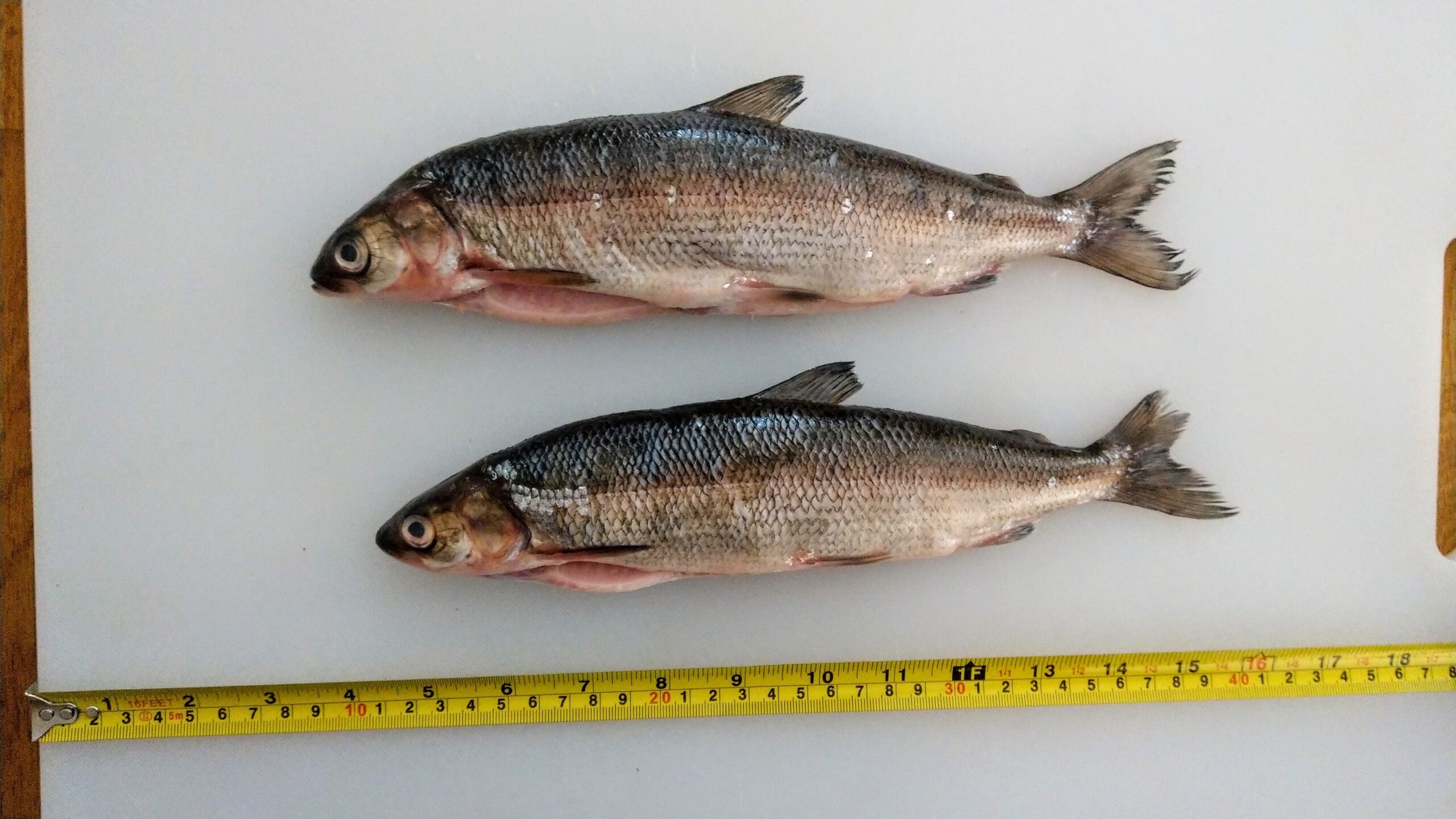
Brine ingredients:
- Three-quarter cup or 200 g of salt
- Three-quarter cup or 160 g of dark brown sugar
- 3 g or 1 teaspoon whole black peppercorns
- 1 tablespoon or 11 g of smoked paprika
- 2 g or 1 teaspoon of whole allspice
- 4 g or five pieces of long pepper
- 3 g of Birdseye chilis (dried)
Combine the above with 1.5 quarts/liters of cold water and bring to a boil. Hold at boiling point for five minutes, and then remove from heat and allow to cool completely.
When the brine is cool:
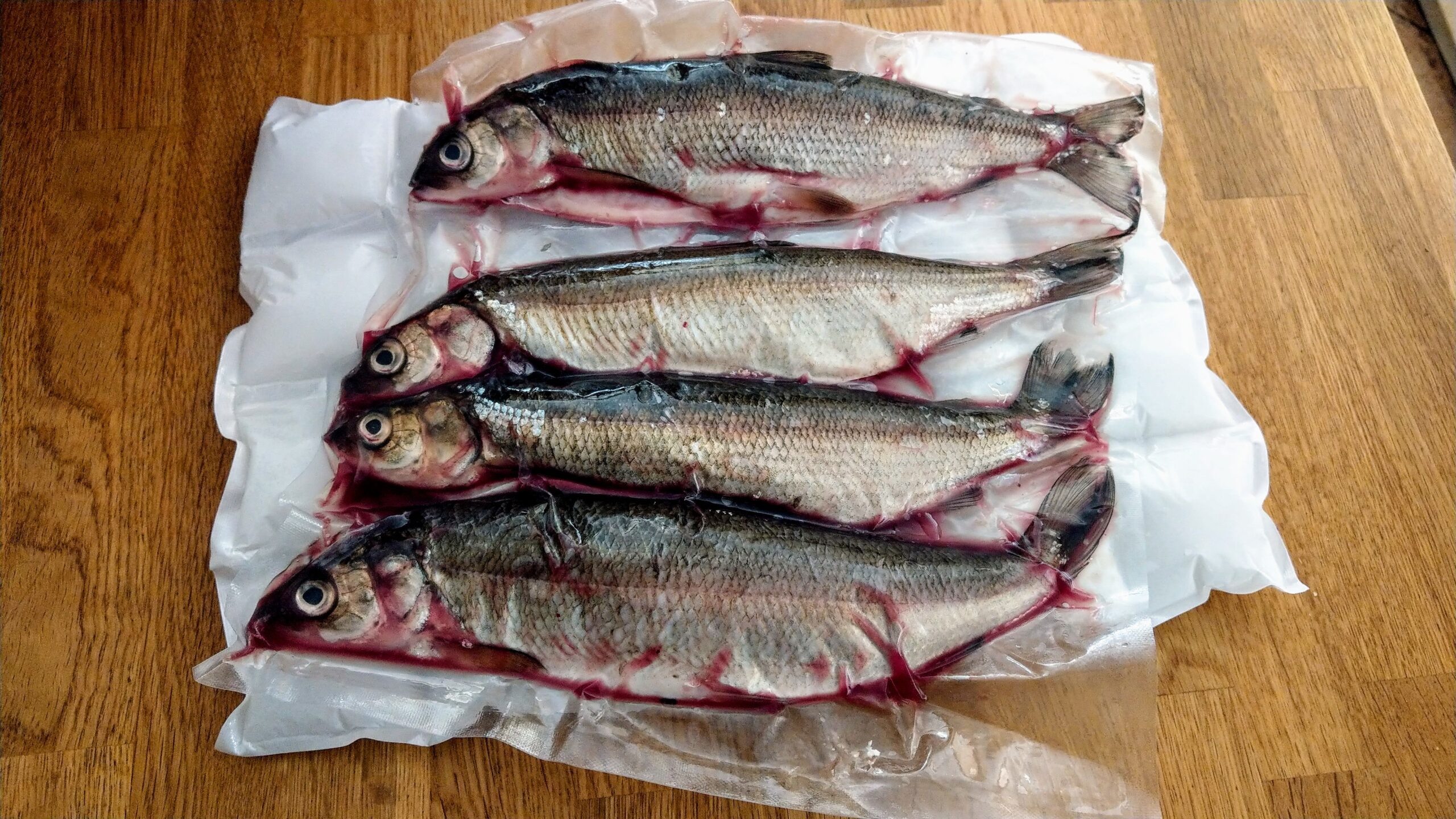
Clean and gut your fish (if your local fisherperson or seafood merchant hasn’t already handled this for you). Scale the fish carefully and rinse in fresh water.
Put the fish in your chosen nonreactive brining vessel…
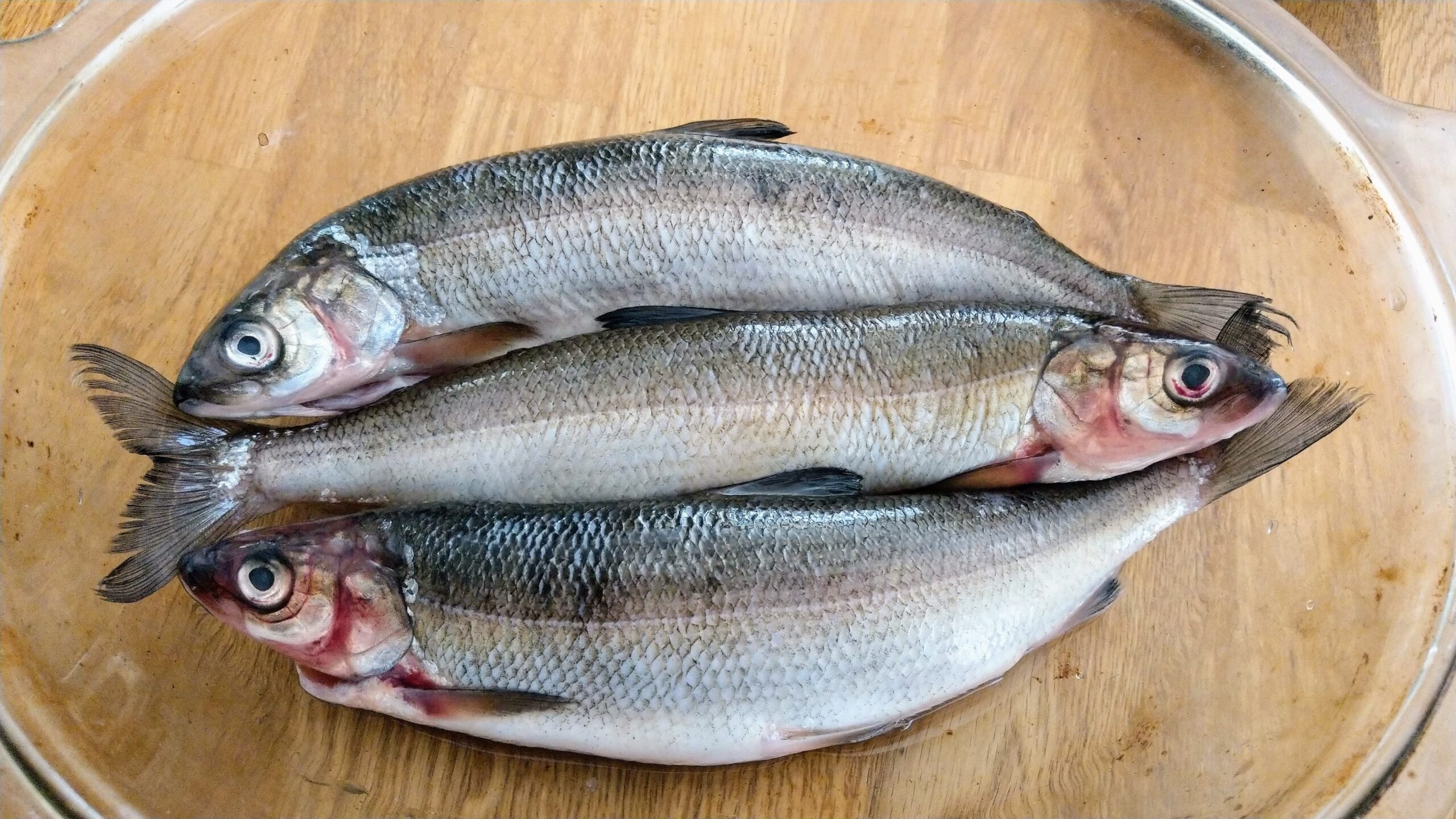
…and pour the brine over, submerging them as completely as possible.
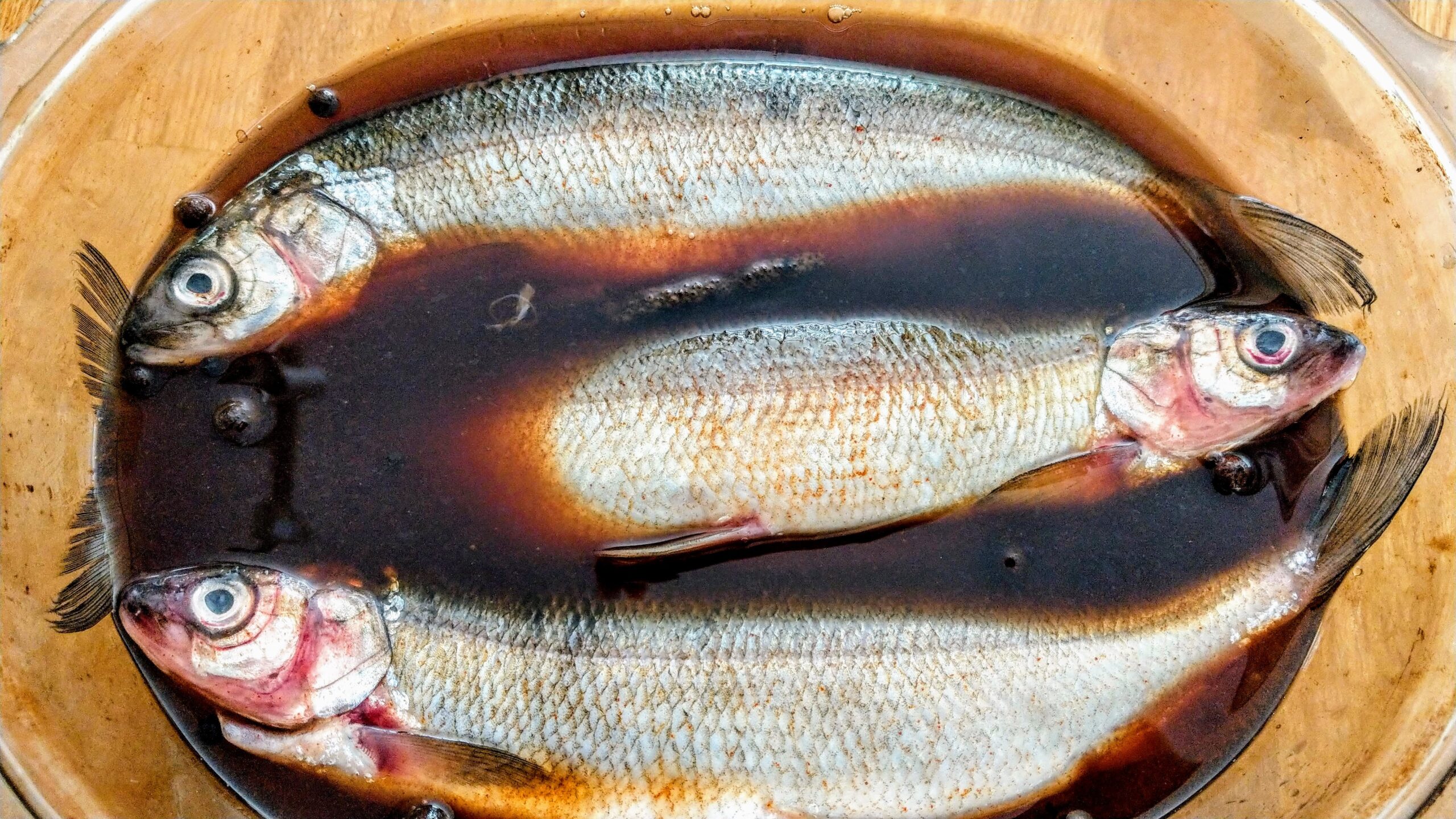
Cover the container tightly and refrigerate for at least 48 hours: 72 hours is preferable. Turn the fish in the brine once a day: twice, if you think of it.
Then, when ready to smoke, remove the fish from the brine, drain well and pat dry.
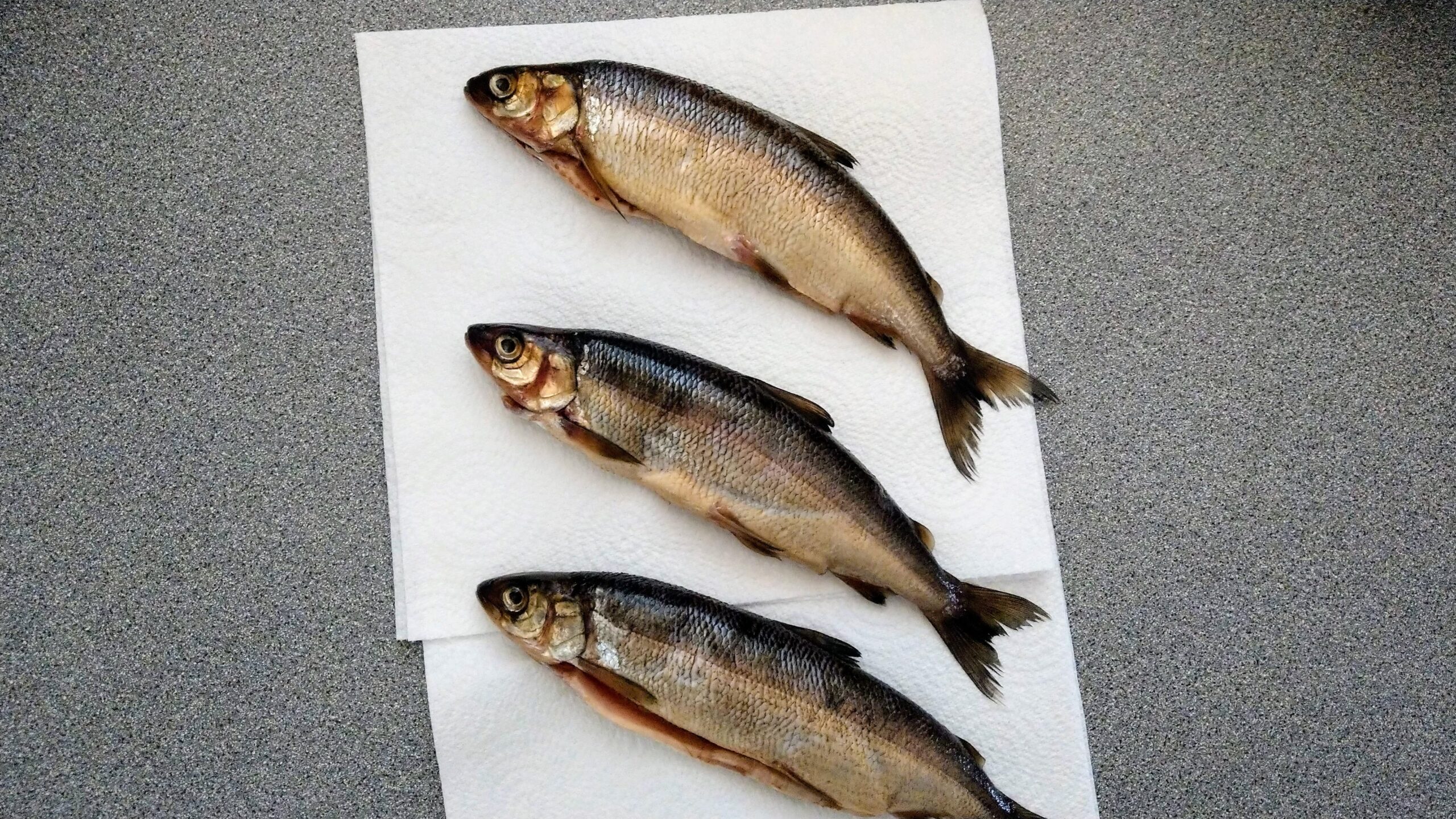
To assist the fish in “taking up the smoke” in the next step, place them on a rack in the refrigerator, or a cool dry space with some air movement, and allow them to dry slightly until tacky. This drying process is sometimes called “developing a pellicule,”, and if you have time to spare for it, it does make a difference.
When the fish has dried off a little, prepare your smoker with a fire suitable for hot smoking. (We smoked ours over oak chips: apple will also work if you prefer a lighter flavor.)
Using hooks or twine, hang the white fish up by their heads in the highest part of the smoker—piercing them behind the head and through the gills is usually best, to keep them from dropping off the hooks in the smoking process—and smoke for approximately 30-40 minutes, to 150F/63C on a digital thermometer. (The flesh should flake easily.) Then carefully remove and set aside to cool.
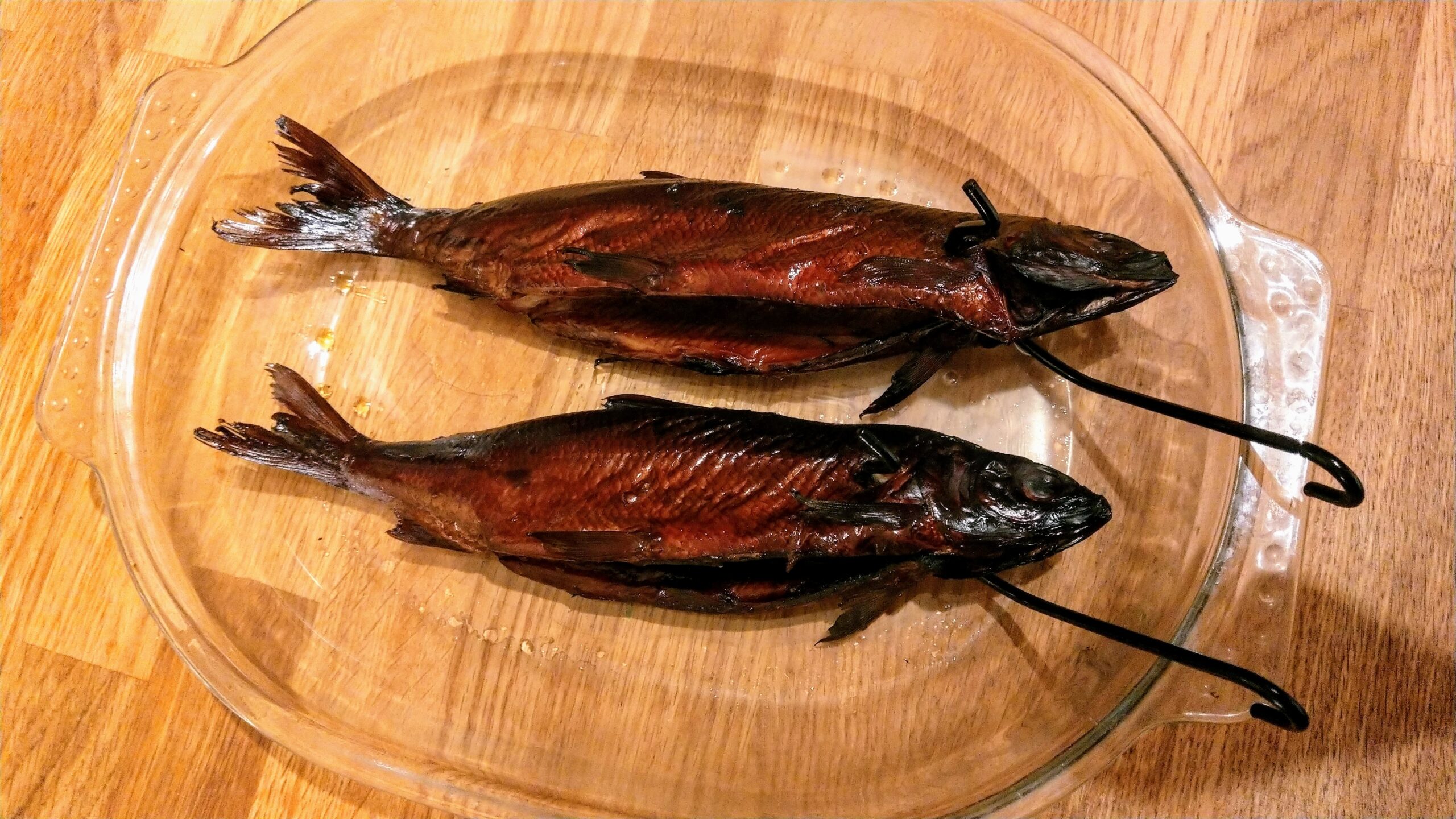
Please note that this kind of smoking is not intended for prolonged preservation. Fish smoked this way should be refrigerated until eaten.
Serve the hot-smoked fish warm or cool with a chilled salad or cooked-and-cooled vegetable, possibly tossed with a spiced vinegar dressing. (A favorite approach in Arlen is a thin-sliced multi-vegetable “slaw” like the one in our top image.)
Enjoy!
Meat, poultry, fast food